Thursday, March 10, 2016

Zika: What you should know now

Every day, we’re learning more about Zika.

Zika is a virus mainly spread by mosquitoes. More than two dozen countries in the Americas have reported active cases and the World Health Organization has issued a public health emergency.

Most of the time, Zika is a mild illness that goes away in a week.
Common symptoms include fever, rash, joint pain and pink eye. It’s rare to die from Zika. So if it’s so mild, why is everyone talking about Zika right now? Good question.

The main concern is the virus’ link to birth defects. While not proven for sure, health officials think Zika may be linked to microcephaly, in which a baby is born with a small head and may have potential developmental issues. Another concern is Guillain-BarrĂ© syndrome, a rare condition that causes nerve damage and paralysis, though the link to Zika hasn’t been proven on that either.

No Zika cases have been reported from mosquitoes in the continental United States, though Puerto Rico is struggling with the virus. There are some cases of Zika in the U.S. from travelers who caught it elsewhere. And some people in the U.S. have acquired it by having sex with partners who were infected during their travels

Health officials are predicting there’s a good chance that Zika will be spread by mosquitoes here eventually, as the type of mosquito that spreads the disease lives in the U.S.

So right now, you’re probably wondering, “How do I keep mosquitoes away from me?” The Centers for Disease Control and Prevention has this advice:

  • Wear long sleeve shirts and pants. 
  • Stay and sleep in places with air conditioning or window and door screens.
  • Use insect repellents approved by the Environmental Protection Agency and use as directed.

For more tips on Zika that you can share with your family, friends and community, download our new fact sheet. And check out our latest Get Ready Report podcast for more insights.

Tuesday, March 08, 2016

Black History Month preparedness profile: Julius Becton, first African-American FEMA director

From the White House to the Department of Transportation to Congress, black Americans hold prominent leadership positions throughout U.S. government. They’ve also played important roles in our nation’s preparedness.

As a tribute to Black History Month, which was observed in February, Get Ready is highlighting an African-American who held a key position in U.S. disaster readiness. From 1985-1989, Julius Becton Jr. served as the third director of the Federal Emergency Management Agency, becoming the first African-American director of the agency.

Nearly 100 disasters were declared in the U.S. during Becton’s years in office, from hurricanes, tornadoes and typhoons to flooding, mudslides and fires. But Becton was dealing with more than just weather emergencies as FEMA director.

Becton assumed office during troubled times for FEMA. The agency had come under investigation for misuse of funds, leading to the resignation of his predecessor. During his term, Becton was known for his dedication to restoring integrity to the agency. He also stressed the importance of preparing Americans for disasters and alerting them if there was a threat.

That readiness went beyond weather disasters. In testimony before Congress in 1988 on FEMA’s civil defense budget, Becton spoke about the role of government to assist and support Americans in the event of a nuclear attack. Becton’s testimony came just two years after the Chernobyl nuclear power plant disaster in the Ukraine, which raised concerns about radiological threats.

“Governments must be able to remain in operation to warn their people, broadcast lifesaving information to them, direct operations such as rescue, firefighting and debris removal and communicate to higher levels to request help,” he said, stressing the importance of disaster warning systems.

Four major emergency management documents were signed during Becton’s term at FEMA, addressing emergency coordination, national security and nuclear power plant safety.

Becton has also been lauded for his work beyond FEMA. After his term at FEMA, he worked in education, including serving as superintendent of the Washington, D.C., public school system. For his almost 40 years of service in the U.S. Army, where he reached the rank of lieutenant general, he received the George C. Marshall Medal, the Association of the U.S. Army’s highest award. Ebony Magazine listed him as “One of the Most Influential Blacks in America” on several occasions.

Now retired, Becton’s work as a leader in U.S. preparedness and service to the nation are still remembered.

Friday, February 12, 2016

Send a dozen e-cards this Valentine's Day

APHA’s Get Ready campaign has created more than a dozen Valentine’s Day ecards to help you send just right message to those you care about. Whether it’s puppy love, earth shaking passion or sheltering in place we have you covered. 

And if things don't go exactly as planned, we've got one for that too.

View all Get Ready Valentine's Day e-cards.
 
  
I feel the earth move... Let's make sure we're ready in case an earthquake hits.
Hey, girl. This Valentine's Day, my shelter-in-place or yours?
Let's take our Valentine's Day convo to the next level...bit.ly/getvax

Even puppy love deserves a plan for emergencies. From snowstorms to the flu, let's prepare for winter weather together.

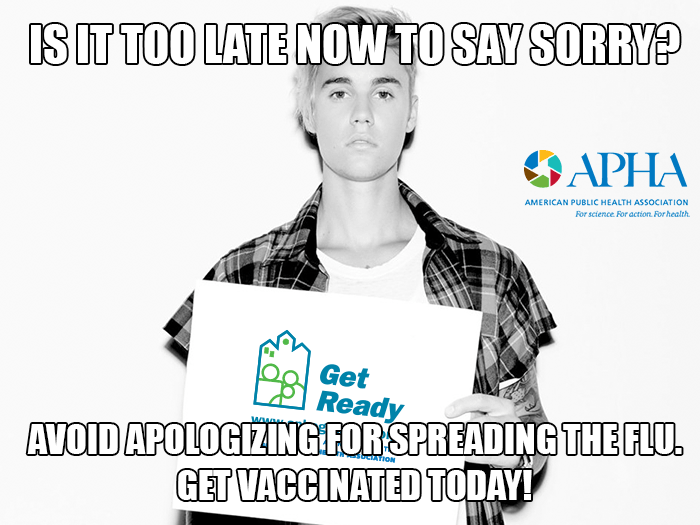
Is it too late now to say sorry? Avoid apologizing for spreading the flu. Get vaccinated today.

Monday, February 08, 2016

Get Ready Mailbag: De-bunking flu shot myths

Welcome to another installment of the Get Ready Mailbag, when we take time to answer questions sent our way by readers like you. Have a question you want answered? Send an email to getready@apha.org.

My family talked about the flu over the holidays. I was surprised to learn my aunt didn’t get her flu shot this year. And my brother said he doesn’t need a flu shot because he’s young and healthy. How can I set them straight?

Thanks for asking! The best way to counter misinformation is with the facts. Let’s debunk some of the most common misconceptions related to the flu vaccine.

Myth: The flu shot can give you the flu
The facts: The flu shot is made from inactivated forms of the flu virus. It can’t give you the flu. It’s possible your aunt had side effects like soreness from her vaccination. Or that she caught the flu before her shot took effect, as the vaccine needs about two weeks in your body before it can fully protect you from the flu. But her shot did not give her the flu.

Myth: Healthy people don’t a need flu shot
The facts: Some people are more likely to get the flu than others, including seniors and those with chronic illness. But even healthy people can catch the flu and become sick. Also, people with the flu can spread it to others. So the shot will protect your brother and everyone he interacts with, like your parents and your kids.

Myth: You don’t need a shot every year
The facts: Even if you got your flu vaccination last year, flu viruses are always changing. Scientists update what’s in the flu shot each year to give you the best chances of avoiding the strains that are circulating. Also, flu shot protection wanes over time, meaning last year’s shot doesn’t offer any protection now.

Myth: By this time of year, it’s too late to get a flu shot
The facts: It’s not too late! Flu is occurring around the country right now.Getting the flu shot today can still protect you.

We hope you share these facts with your family members! Find a convenient location to get your flu shot with Healthmap Vaccine Finder. And learn even more about the flu with our Get Ready fact sheet.


Thursday, January 07, 2016

New year, new chances to be prepared with APHA’s Get Ready calendar

First-place runners-up poll winner
by Mary-Kate Duffy
2016 is here! Looking for a place to write down all your New Year’s resolutions? What if you could track those healthy habits while also learning how to be better prepared for emergencies?

Download APHA's Ready, Pet, Go! Get Ready Calendar and get started today! The 2016 calendar, which is available online, showcases adorable animal pictures from our photo contest and ways to keep you and your loved ones safe. With these great preparedness tips, you’re sure to have the best — and safest — year yet.

And while you’re on our website, don’t miss the winners of our runners-up poll! We had so many great entries from our calendar photo contest, we decided we had to share more than just the winners. The beautiful bird photo by Mary-Kate Duffy earned almost a third of your votes. Our second-place runner-up was the cat by Michele Samarya Timm, and third was Cooper the dog by Jennifer Simmons. Congrats to our winners and their photogenic animals, and thanks for voting!

Get your copy of the 2016 calendar today and print one to share with family and friends.