Welcome to another installment of the Get Ready Mailbag, when we take time to answer questions sent our way by readers like you. Have a question you want answered? Send an email to getready@apha.org.
My family talked about the flu over the holidays. I was surprised to learn my aunt didn’t get her flu shot this year. And my brother said he doesn’t need a flu shot because he’s young and healthy. How can I set them straight?
Thanks for asking! The best way to counter misinformation is with the facts. Let’s debunk some of the most common misconceptions related to the flu vaccine.
Myth: The flu shot can give you the flu
The facts: The flu shot is made from inactivated forms of the flu virus. It can’t give you the flu. It’s possible your aunt had side effects like soreness from her vaccination. Or that she caught the flu before her shot took effect, as the vaccine needs about two weeks in your body before it can fully protect you from the flu. But her shot did not give her the flu.
Myth: Healthy people don’t a need flu shot
The facts: Some people are more likely to get the flu than others, including seniors and those with chronic illness. But even healthy people can catch the flu and become sick. Also, people with the flu can spread it to others. So the shot will protect your brother and everyone he interacts with, like your parents and your kids.
Myth: You don’t need a shot every year
The facts: Even if you got your flu vaccination last year, flu viruses are always changing. Scientists update what’s in the flu shot each year to give you the best chances of avoiding the strains that are circulating. Also, flu shot protection wanes over time, meaning last year’s shot doesn’t offer any protection now.
Myth: By this time of year, it’s too late to get a flu shot
The facts: It’s not too late! Flu is occurring around the country right now.Getting the flu shot today can still protect you.
We hope you share these facts with your family members! Find a convenient location to get your flu shot with Healthmap Vaccine Finder. And learn even more about the flu with our Get Ready fact sheet.

Showing posts with label flu. Show all posts
Showing posts with label flu. Show all posts
Monday, February 08, 2016


Thursday, December 17, 2015
Infographic: 5 ways to prevent the flu
Do you know how to prevent the flu? Check out these 5 easy tips.

Text:
Text:
1. Get vaccinated
Getting vaccinated is the most important way you can protect yourself from the flu. When you get vaccinated, you’re much less likely to get sick.
Getting vaccinated is the most important way you can protect yourself from the flu. When you get vaccinated, you’re much less likely to get sick.
2. Wash your hands often
Hand-washing is a great way to get rid of germs. Washing your hands with soap and water before and after eating, after coughing or sneezing and after using the bathroom can make a big difference when preventing flu.
Hand-washing is a great way to get rid of germs. Washing your hands with soap and water before and after eating, after coughing or sneezing and after using the bathroom can make a big difference when preventing flu.
3. Stay away from people who are sick
Keeping your distance from others who have the flu can reduce your chance of getting sick. Flu viruses can spread through air and via surfaces, so stay away from people who are sick.
Keeping your distance from others who have the flu can reduce your chance of getting sick. Flu viruses can spread through air and via surfaces, so stay away from people who are sick.
4. Avoid touching your eyes, nose or mouth with your hands
Touching surfaces that are contaminated with germs and then touching your eyes, nose or mouth can allow for the flu virus to enter your body.
Touching surfaces that are contaminated with germs and then touching your eyes, nose or mouth can allow for the flu virus to enter your body.
5. Practice good hygiene
Clean surfaces and objects in your home, at work, at school and elsewhere to reduce the chances of spreading the flu.
Clean surfaces and objects in your home, at work, at school and elsewhere to reduce the chances of spreading the flu.
Friday, November 06, 2015
From the archive: Got asthma? An extra reason to get your flu shot
This post originally appeared on our blog in November of 2008:
Fever, aches and chills. Yuck! Flu season is upon us, and for many who come down with these symptoms, a few days in bed and plenty of fluid may be just what the doctor orders. But if you’re one of the more than 22 million Americans with asthma, the flu can lead to conditions that are much worse.
When you have asthma, your airways are already somewhat inflamed. They overreact to irritants and allergens, including viruses. Rather than fighting the virus, your lungs may secrete substances that promote inflammation. Making matters worse, viruses can replicate themselves more extensively in lungs affected by asthma than in healthy lungs.
Therefore, many health experts recommend that people with asthma get an annual flu shot. According to the Centers for Disease Control and Prevention, people with asthma are at high risk of developing complications after contracting the flu virus, yet most adults with asthma don’t get their annual flu shot.
So if you have asthma, take steps to protect yourself from flu: Avoid people who are sick. Wash your hands regularly. And if you haven’t gotten your flu shot, get one today.
Fever, aches and chills. Yuck! Flu season is upon us, and for many who come down with these symptoms, a few days in bed and plenty of fluid may be just what the doctor orders. But if you’re one of the more than 22 million Americans with asthma, the flu can lead to conditions that are much worse.
 |
| Photo: Patrick Benko |
Therefore, many health experts recommend that people with asthma get an annual flu shot. According to the Centers for Disease Control and Prevention, people with asthma are at high risk of developing complications after contracting the flu virus, yet most adults with asthma don’t get their annual flu shot.
So if you have asthma, take steps to protect yourself from flu: Avoid people who are sick. Wash your hands regularly. And if you haven’t gotten your flu shot, get one today.
Wednesday, January 21, 2015
Friday, January 09, 2015
Flu season intensifies across the US
The following originally appeared on APHA’s Public Health Newswire blog.
Flu cases are on the rise. According to the Centers for Disease Control and Prevention's latest edition of FluView, its weekly influenza surveillance report, U.S. flu activity is increasing in strength and expanding its reach to more areas of the country. As of Dec. 27, 43 states reported “high or widespread influenza activity,” resulting most commonly from drifted influenza A viruses, or H3N2.
Data from CDC’s FluView on the 2014-2015 flu season also shows that 3,441 laboratory-confirmed influenza-associated hospitalizations have been reported since Oct. 1; for the week of Dec. 27, 5.9 percent of all clinic visits were for patients seeking treatment for influenza-like illness, an elevated level for the sixth week in a row; and 21 influenza-associated pediatric deaths have been reported.
These trends are consistent with what CDC officials have seen over the past several flu seasons. With January or February typically being the worst months for flu, activity could continue to rise.
There are many ways you can protect yourself and others from the flu, including:
- Getting your annual seasonal flu vaccine, which is the best way to reduce your chance of getting the flu. It’s not too late to get vaccinated.
- Washing your hands often with soap and water, and covering your nose and mouth with a tissue if you cough or sneeze.
- If you do experience flu-like symptoms, staying home and limit contact with others.
You can also find out more about flu prevention at APHA’s Get Ready campaign, including fact sheets and other helpful resources.
Monday, December 08, 2014
It’s not too late: Dec. 7-13 is National Influenza Vaccination Week
Dec. 7-13 is National Influenza Vaccination Week, an observance organized by the Centers for Disease Control and Prevention to highlight the importance of annual flu immunizations.
It’s a particularly important reminder this year. On Wednesday CDC announced that the strain of this year’s most common virus, H3N2, has mutated, possibly reducing the vaccine’s ability to protect against those viruses. Flu seasons with predominantly H3N2 viruses often bring more severe flu cases, including more hospitalizations and deaths.
“It’s too early to say for sure that this will be a severe flu season, but Americans should be prepared,” CDC Director Tom Frieden said in a news statement. “We can save lives with a three-pronged effort to fight the flu: vaccination, prompt treatment for people at high risk of complications and preventive health measures, such as staying home when you’re sick, to reduce flu spread.”
Getting your flu shots remains vital; it provides protection against mutated, or “drifted,” viruses in past seasons and offers protection against other flu viruses that could become common later in the flu season. Flu activity commonly peaks in the U.S. in January or February.
Everyone who is at least 6 months of age should get a flu shot, according to CDC, while healthy children ages 2-8 should get a nasal spray vaccine.
Take and share CDC’s flu pledge to protect yourself and those around you by getting vaccinated. And visit APHA’s Get Ready blog for a variety of resources, including vaccination fact sheets for kids, teens and adults.
Cross posted from APHA's www.publichealthnewswire.org.
Friday, February 21, 2014
What to know and do about flu

On Feb. 20, CDC announced that the current flu season has been hard on young and middle-aged adults, with people ages 18-64 accounting for 61 percent of flu hospitalizations. CDC noted that the season is still ongoing and it’s not too late to get a flu shot.
Winter is in full swing and flu activity is elevated nationwide. Getting a flu vaccination now may still help protect you from becoming sick this winter and spring. In fact, the Centers for Disease Control and Prevention recommends that flu vaccination continue into February and beyond, as long as flu viruses are circulating.
Should you get the flu vaccine if you’ve already been sick with the flu this season? Yes. Even if you’ve had the flu, it is possible to get it again. Many different types of flu viruses circulate each winter and spring, and getting vaccinated now may protect you from one of the other flu viruses to which you may be exposed.
Even healthy people can benefit from a flu vaccine. Getting vaccinated protects you and those around you, especially people who are at high risk for flu complications, such as people with chronic disease, seniors, pregnant women and young children. Babies under 6 months are too young to get vaccinated, so the best way to protect them is for everyone around them to get vaccinated.
In addition to getting vaccinated, you can take everyday preventive actions to help reduce the spread of germs. Try to avoid contact with people who are sick. If you or your child gets sick, stay home from work or school. Cover your coughs and sneezes with a tissue and throw the tissue in the trash. Wash your hands often with soap and water or use hand sanitizer to keep from spreading flu to others.
Flu symptoms usually come on suddenly and include some or all of these: fever or feeling feverish/chills, cough, sore throat, runny or stuffy nose, muscle or body aches, headaches and fatigue. Some people may have vomiting and diarrhea, though this is more common in children than adults. It’s also important to remember that not everyone with flu will have a fever.
If you get the flu, prescription antiviral drugs are a treatment option. Many people can benefit from taking antiviral drugs like Tamiflu that can shorten the time you are sick and lessen the severity of symptoms. Antiviral medicines work best when started soon after symptoms develop, so people — especially high risk groups — should seek medical care ASAP.
Flu can be a very serious disease. Do your part to protect against the flu and encourage others to do the same.
Find a flu vaccine provider at http://vaccine.healthmap.org/. Join @CDCFlu and APHA’s @GetReady on social media to share the news of your vaccination by posting a message using #vaxwithme. In doing so, you will help remind and encourage others to get vaccinated.
Friday, January 24, 2014
Get the facts about the Flu and Flu Vaccine
Today’s guest blog is by Michael Jhung, MD, MPH, MS, a medical officer for the Surveillance and Outbreak Response Team in the Influenza Division, National Center for Immunization and Respiratory Diseases, at the Centers for Disease Control and Prevention.
I bet you’ve heard a statement or two about seasonal flu and the flu vaccine and wondered if it was true or not. To help you make sense of those statements, I’d like to explain some of the important facts about seasonal flu and flu vaccination.
Flu vaccines cannot give you the flu. The flu vaccine contains viruses that are either killed or weakened, which means they cannot cause infection. There are even some flu vaccines that contain no flu viruses at all. Sometimes, though, people mistake the mild side effects from vaccination for actual flu illness and, at other times, people can still get the flu even after they’ve had the flu vaccine. Common flu shot side effects are a sore arm and, sometimes, a low fever or achiness. The nasal spray flu vaccine might cause congestion, runny nose, sore throat or a cough. Side effects are often mild and last one to two days.
Flu can be a very serious disease. Some people are at a higher risk of complications from flu that can result in hospitalization and sometimes death. This includes young children, pregnant women, older adults and people with certain chronic health conditions, asthma, diabetes or heart disease. Keep in mind though that even healthy children and adults can get sick with flu and spread it to others. Getting vaccinated is the best protection against influenza, even if you’ve already had the flu this fall or winter.
You need to get a flu vaccine every year. The Centers for Disease Control and Prevention says annual vaccination for everyone 6 months and older is necessary because flu viruses are constantly changing, and flu vaccines may be updated from one season to the next to protect against the viruses research indicates will be most common during the upcoming flu season. Additionally, a person’s immune protection from the vaccine declines over time. It’s important to remember that some children 6 months through 8 years will need two flu vaccines spaced at least 28 days apart during their first year of vaccination.
As long as the flu is circulating, flu vaccination should continue. A flu vaccination protects you and those around you. Seasonal flu usually peaks in January or February, but can occur as late as May. If you haven’t gotten your flu vaccine yet, find a vaccine provider near you at http://vaccine.healthmap.org/.
Join @CDCFlu and @GetReady on social media to share the news of your vaccination by posting a message using #vaxwithme. In doing so, you will help remind and encourage others to get vaccinated – it’s the best protection.
I bet you’ve heard a statement or two about seasonal flu and the flu vaccine and wondered if it was true or not. To help you make sense of those statements, I’d like to explain some of the important facts about seasonal flu and flu vaccination.
Flu vaccines cannot give you the flu. The flu vaccine contains viruses that are either killed or weakened, which means they cannot cause infection. There are even some flu vaccines that contain no flu viruses at all. Sometimes, though, people mistake the mild side effects from vaccination for actual flu illness and, at other times, people can still get the flu even after they’ve had the flu vaccine. Common flu shot side effects are a sore arm and, sometimes, a low fever or achiness. The nasal spray flu vaccine might cause congestion, runny nose, sore throat or a cough. Side effects are often mild and last one to two days.
 |
| CDC/James Gathany |
You need to get a flu vaccine every year. The Centers for Disease Control and Prevention says annual vaccination for everyone 6 months and older is necessary because flu viruses are constantly changing, and flu vaccines may be updated from one season to the next to protect against the viruses research indicates will be most common during the upcoming flu season. Additionally, a person’s immune protection from the vaccine declines over time. It’s important to remember that some children 6 months through 8 years will need two flu vaccines spaced at least 28 days apart during their first year of vaccination.
As long as the flu is circulating, flu vaccination should continue. A flu vaccination protects you and those around you. Seasonal flu usually peaks in January or February, but can occur as late as May. If you haven’t gotten your flu vaccine yet, find a vaccine provider near you at http://vaccine.healthmap.org/.
Join @CDCFlu and @GetReady on social media to share the news of your vaccination by posting a message using #vaxwithme. In doing so, you will help remind and encourage others to get vaccinated – it’s the best protection.
Monday, December 09, 2013
Flu season is here: Vaccination is your best protection
|
| Dr. Michael Jhung, medical officer for the influenza division, Centers for Disease Control and Prevention |
The most recent Centers for Disease Control and Prevention data show nearly all states reporting some level of flu activity. While flu activity nationally remains low, it has been increasing and is likely to continue rising in the coming weeks. If you have not already gotten a flu vaccine this season, you should do so now. The flu vaccine is the best protection against the flu and any potential serious complications.
In the United States each year, on average, 5 percent to 20 percent of the population gets the flu and more than 200,000 people are hospitalized from seasonal flu-related complications. Last flu season was a stark reminder of how severe influenza can be. There were high influenza hospitalization rates, especially in the elderly. CDC saw the highest proportion of persons 65 and older hospitalized for flu since tracking began during the 2005-2006 season. And sadly, the number of pediatric deaths was one of the highest since flu tracking began.
For these reasons, CDC recommends that everyone 6 months and older receive an annual flu vaccination. It is especially important that people at high risk of flu-related complications get vaccinated. This includes pregnant women; children younger than 5, but especially those younger than 2 years; adults 65 and older; and people with chronic diseases such as asthma, heart disease and diabetes. Also, it’s especially important that people living with or caring for people who are at high risk of flu complications be vaccinated; this includes health care professionals and those living with children younger than 6 months of age, as they are too young to be vaccinated.
The good news this year is there are more flu vaccine options than there have ever been. CDC does not recommend one type of flu vaccine over the others; the important thing is to get vaccinated. To find vaccine near you, visit http://vaccine.healthmap.org.
Join @CDCFlu and @GetReady on social media to share the news of your vaccination by posting a message using #vaxwithme. In doing so, you will help remind and encourage others to get vaccinated — it’s the best protection.
Tuesday, October 29, 2013
Infections are scarier than any Halloween costume, but not if you’re prepared
We don’t want you to be frightened on Halloween — except for the costumes. The Get Ready campaign can’t prevent Michael Myers or Hannibal Lector from showing up on your doorstep, but we can help prevent you from catching infectious diseases.
If you’re not careful, you might be at greater risk of catching infectious diseases such as the flu on Halloween. But fear not — you can help keep those scary viruses and bacteria away if you follow three easy steps:
- Get your flu shot: Halloween falls right in the middle of flu season, which can make you really sick. Flu viruses can spread when someone with the infection coughs or sneezes —and with 41 million trick-or-treaters in the U.S., there’s a lot of people who could infect you.
If you haven’t gotten your flu vaccination yet, you can find a place nearby to get your flu shot online via HealthMap. Just plug in your location and find a place that can give you the immunization you need.
Getting vaccinated against infectious diseases is really important, no matter how old you are. Check out our Get Ready fact sheets for kids (English or Spanish), teens (English or Spanish) and adults (English or Spanish) for more info. - Wash your hands, cover your cough: Cover your cough or sneeze with a tissue or into your upper sleeve or elbow if you don’t have one. And before you eat any of your treats, make sure to wash your hands with soap and warm water for at least 20 seconds.
You might be touching candy bowls, pumpkins or even your best friend’s costumes. Make sure you’re not spreading germs when you do.
- Be careful with candy: Those wrappers are on your favorite treats to keep you safe! If you see a piece of candy that isn’t wrapped, stay away from it. Who knows where it’s been? Someone may have gotten some dangerous germs onto it.
Also, if your friend is eating something that looks really delicious, don’t ask for a bite. Get your own! Your trick-or-treat buddy might not be as safe as you are, so avoid sharing food.
Thursday, October 10, 2013
Guest blog: Cold and flu symptoms? Double-check, don’t double up
With flu season underway, the Know Your Dose campaign educates people about the safe and effective use of acetaminophen, the active ingredient in many over-the-counter flu medicines. Today’s guest blog comes from Kathleen Wilson, PhD, ARNP-C, who is active with the campaign, and reminds people to take care when taking flu medicines.
 Wilson is a board-certified family and pediatric nurse practitioner with 28 years of experience in providing care for patients of all ages. She has held positions in education, practice, research, administration and consultancies with extensive experience in adolescent health, behavioral health, management of children and youth with special needs and community program development. She practices in Tallahassee, Fla.
The American Association of Nurse Practitioners is a founding member of the Acetaminophen Awareness Coalition, which formed the Know Your Dose campaign to educate patients about the safe use of acetaminophen. I advise my patients who will be using cold and flu medicines to double-check their medicine labels so they don’t double up on acetaminophen, and follow these four simple safety steps:
Wilson is a board-certified family and pediatric nurse practitioner with 28 years of experience in providing care for patients of all ages. She has held positions in education, practice, research, administration and consultancies with extensive experience in adolescent health, behavioral health, management of children and youth with special needs and community program development. She practices in Tallahassee, Fla.
APHA is an organizational partner of the Know Your Dose campaign.
Each year, the most common question my patients ask about cold and flu season is how to avoid getting a cold or flu. Everyone has their favorite remedies and techniques for keeping germs at bay, and frequent hand-washing and use of sanitizer do help. Of course, getting your flu vaccination is important as well. But despite taking precautions to ward off the sniffles, it’s hard to avoid catching a cold or flu. Americans catch an estimated 1 billion colds every year, and roughly 20 percent get the flu.
Each year, the most common question my patients ask about cold and flu season is how to avoid getting a cold or flu. Everyone has their favorite remedies and techniques for keeping germs at bay, and frequent hand-washing and use of sanitizer do help. Of course, getting your flu vaccination is important as well. But despite taking precautions to ward off the sniffles, it’s hard to avoid catching a cold or flu. Americans catch an estimated 1 billion colds every year, and roughly 20 percent get the flu.
In the coming months, the majority of people will find themselves at the local pharmacy searching for an over-the-counter medicine to relieve their symptoms. One trip down the cold and flu aisle will show you that there are countless medicines available, and what people often don’t realize is how many of their trusted cold and flu medicines contain the most common drug ingredient in America: acetaminophen. It is found in more than 600 over-the-counter and prescription medicines, including pain relievers, fever reducers and sleep aids, as well as many cough and cold medicines.
Acetaminophen is safe and effective when used as directed, but taking more than directed is an overdose and can lead to liver damage. So, I remind my patients that it is always important to read and follow the labels to know the ingredients in the medicines they take, particularly if they are taking both an over-the-counter medicine in addition to a prescription medicine containing acetaminophen.
- Know if medicines contain acetaminophen, which is in bold type or highlighted in the “active ingredients” section of over-the-counter medicine labels and sometimes listed as “APAP” or “acetam” on prescription labels.
- Never take two medicines that contain acetaminophen at the same time.
- Always read and follow the medicine label.
- Ask your health care provider or a pharmacist if you have questions about dosing instructions or medicines that contain acetaminophen.
Friday, August 30, 2013
Back-to-school preparedness tips
School’s back in session, so now’s a good time to brush up on ways to keep kids safe from disasters and other emergencies.
• Practice good hand hygiene: Teach your children to wash their hands after group activities and most importantly after using the restroom and before eating. The Get Ready campaign has great fact sheets about hand-washing that you and your kids can read together.
• Get a flu shot! Everyone ages 6 months and older should get a seasonal flu shot every year, says the Centers for Disease Control and Prevention. Remember to stay home when you are sick to prevent spreading flu. While you’re at it, make sure that your children are up to date on all of their other shots. Be sure you’re immunized, too, so you don’t pass along diseases to young children. Adults should especially be sure to stay immunized against pertussis, also known as whooping cough, as they can transmit it to infants.
• Prepare for an emergency: Disasters can happen suddenly, meaning there is a chance you can get separated from your child during an emergency. As parents, it’s a good idea to learn about the emergency preparedness plans at your children’s schools and get involved in the planning process. Make sure your child knows his or her address, your emergency meeting place, the full names of parents or guardians and important phone numbers.
• Make getting prepared fun: The Get Ready campaign has free games and puzzles kids can play to learn about preparedness, as well as fact sheets written at their level. Great for use in classrooms as well!
For more information, check out and share our Get Ready parent’s page.
Thursday, April 25, 2013
National Infant Immunization Week: Keeping children healthy
It’s National Infant Immunization Week! The observance, which runs April 20-27, promotes the benefits of immunizations and works to improve the health of children. While immunization is important for overall health, it also helps people be more prepared for emergencies.
“Immunization is a personal preparedness step that can promote day-to-day emergency readiness and build a stronger public health system,” Steve Krug, chairperson of the American Academy of Pediatrics Disaster Preparedness Advisory Council, told the Get Ready campaign.
Immunizations are among the most successful and cost-effective public health tools to protect children against preventable diseases and keep them healthy. Each year, immunization of babies prevents 14 million cases of disease.
“Not only do (immunizations) protect vaccinated individuals, but they also help protect entire communities by preventing and reducing the spread of infectious diseases, such as chickenpox, measles and the flu,” Krug said.
Fully immunized children are better protected from diseases such as the flu or whooping cough that spread more easily when people are in close contact with each other. To check if you or your children are up to date on vaccinations, check out these immunization schedules recommended by the Centers for Disease Control and Prevention.
For more information on how vaccines help protect us from disease, download our fact sheet with general information on vaccines or our fact sheet on vaccinations for kids.
Friday, April 19, 2013
H7N9 influenza: What you should know now
|
| Dr. Michael Jhung, medical officer for the influenza division, Centers for Disease Control and Prevention |
Not long after a newsworthy 2012-2013 influenza season, flu is in the headlines again. On April 1, the World Health Organization first reported three human infections with a new influenza A (H7N9) virus in China. Since then, additional cases have been reported. Most of the people reportedly infected have had severe respiratory illness and, in some cases, have died.
Fortunately, there are currently no reported cases of H7N9 in the U.S. or anywhere outside of China. At the Centers for Disease Control and Prevention, we are following this situation closely, coordinating with domestic and international partners, taking routine preparedness steps and sharing frequent updates.
Here are some things you should know about the current H7N9 situation:
- It is still early in the response and there is a tremendous amount that we don’t know. Our information is likely to be updated and change frequently as we learn more about H7N9. To stay informed, please visit our H7N9 page.
- There are no confirmed cases of human infection in the U.S., and there is currently no evidence that the virus can spread in a sustained way from person-to-person. Other than advice for travelers or people who are ill, CDC is not making any additional or special recommendations for U.S. public action specific to H7N9. Travelers should continue to visit CDC’s Travelers' Health page on H7N9 for CDC’s current travel recommendations.
- After the first human infections with H7N9 were detected in China, Chinese authorities detected H7N9 viruses in poultry in the same area where human infections have occurred. China is investigating cases, their exposures and their contacts closely. Many of the humans infected with H7N9 are reported to have had contact with poultry. The current working assumption is that most human infections with H7N9 have resulted from exposure to infected birds or contaminated environments. The extent of the outbreak in poultry is still being assessed, but China has reportedly begun removing birds from live markets. Shanghai is currently taking extra precautions by closing down its live poultry markets for the time being.
- On Thursday, April 11, CDC received the first H7N9 virus isolate from China. Since this H7N9 virus is new and has pandemic potential, we are using the virus isolate from China to develop a candidate vaccine virus that could be used to make a vaccine if one is needed.
- CDC also is using the virus isolate from China to:
- Develop a test kit for detecting H7N9 infections in humans.
- Test for the presence of antibodies against the H7N9 virus in human blood samples. This will allow CDC to see if some people already have immunity against this virus.
- Test to see whether existing antiviral drugs —i.e., Tamiflu and Relenza — will work to treat people who become ill from H7N9.
- The investigation in China has not revealed any sustained — or ongoing — human-to-human spread of this virus, but non-sustained human-to-human spread of bird flu viruses has occurred in the past, most notably with H5N1. It’s likely that some limited human-to-human spread of H7N9 will occur. Sustained, community transmission is needed for a pandemic to start.
About the author:
Michael Jhung, MD, MPH, MS, is a medical officer for the Surveillance and Outbreak Response Team in the Influenza Division, National Center for Immunization and Respiratory Diseases, at the Centers for Disease Control and Prevention in Atlanta, Georgia. Dr. Jhung received his Bachelor of Science in Kinesiology from University of Michigan in 1989 and his Master of Science in Bioengineering from the University’s College of Engineering in 1994. He completed his doctorate of medicine from Case Western Reserve University School of Medicine in 2002, and his Master of Public Health in Epidemiology from University of Michigan’s School of Public Health in 2004.
Dr. Jhung began working with CDC’s Division for Healthcare Quality Promotion in 2005 as an Epidemic Intelligence Officer, where he conducted surveillance for healthcare-associated adverse events and rapidly responded to requests for assistance with investigation of health-care associated infections. Dr. Jhung graduated from the EIS program and joined Influenza Division’s Surveillance and Outbreak Response Team in 2009, where he has applied his expertise to responding to influenza outbreaks, providing scientific training of Fellows and staff, and contributing key findings to CDC’s pandemic preparedness plans.
Thursday, January 17, 2013
New podcast: Flu season update from CDC
|
| Dr. Jhung, MD, MPH, MS, Medical Officer for the CDC |
More than 40 U.S. states are reporting widespread flu activity in what has turned out to be an early start to the 2012-2013 flu season. The Get Ready campaign spoke with Michael Jhung, a medical officer for the U.S. Centers for Disease Control and Prevention, to get the scoop on this year’s flu season in the latest episode of our Get Ready Report podcast.
Jhung said that this year’s flu season is off to “quite an early start,” and that this year could turn out to be worse than last year’s flu season.
Why worry about the flu? Jhung reported that the flu kills anywhere between 3,000 and 49,000 people in the U.S. each year, and makes thousands more severely ill.
“Influenza puts several hundred thousand people into the hospital every year in the United States,” he said. “Even if you don’t end up in the hospital with influenza, it’s really a miserable experience to be pretty much incapacitated for the few days to week of influenza symptoms.”
If you’ve been lucky enough to avoid the flu so far this year, you can increase your chances of staying healthy by getting a flu shot. That’s right — it’s not too late!
“There is a lot of flu activity out there right now, and there is every reason to go out and get vaccinated if you haven’t been vaccinated already,” Jhung said.
If you are looking for the flu shot, check flushot.healthmap.org to find a location near you.
Jhung also explains during the podcast why some flu seasons are worse than others, and talked about how the CDC monitors flu every year. Plus, he has other useful tips for keeping yourself healthy after you’ve gotten your flu shot.
Check out the podcast for more helpful information about the flu. You can listen to the episode or read the full transcript. And don’t forget to subscribe to our podcast for free via iTunes!
Thursday, December 27, 2012
New report asks: Are we ready or not?
It can be hard to measure how ready we are for emergencies. A new report from Trust for America’s Health and the Robert Wood Johnson Foundation tries to answer that question. The report, “Ready or Not? Protecting the Public from Diseases, Disasters and Bioterrorism” comes out every year and can tell us how prepared we are, state-by-state and as a country.
The report finds that as a country, we have made some progress in getting prepared since 2001 by improving the availability of vaccines and bettering disease monitoring, among other measures. However, budget cuts at the national and state level have stopped the U.S. from making even more progress.
The report ranked states from most to least prepared on a scale of one to 10, with 10 the most prepared. Overall, 35 states and Washington, D.C., scored a six or lower. No states scored 10 out of 10, but five states were ranked as the most prepared, at eight out of 10: Maryland, Mississippi, North Carolina, Vermont and Wisconsin. Kansas and Montana were the least prepared, the report found, scoring a three out of 10. Check out this map to see where your state falls.
Read the report to learn more about why your state was ranked high or low.
How did your state do? What do you think of the report? Let us know in the comments below!
The report finds that as a country, we have made some progress in getting prepared since 2001 by improving the availability of vaccines and bettering disease monitoring, among other measures. However, budget cuts at the national and state level have stopped the U.S. from making even more progress.
The report ranked states from most to least prepared on a scale of one to 10, with 10 the most prepared. Overall, 35 states and Washington, D.C., scored a six or lower. No states scored 10 out of 10, but five states were ranked as the most prepared, at eight out of 10: Maryland, Mississippi, North Carolina, Vermont and Wisconsin. Kansas and Montana were the least prepared, the report found, scoring a three out of 10. Check out this map to see where your state falls.
 |
| [Map, courtesy Ready or Not? 2012, Trust for America's Health and Robert Wood Johnson Foundation] |
Read the report to learn more about why your state was ranked high or low.
How did your state do? What do you think of the report? Let us know in the comments below!
Monday, December 10, 2012
APHA announces winners of its Flu Near You Challenge
Over the past year, the Get Ready campaign has promoted APHA’s Flu Near You Challenge, a contest that asked Association members to recruit users into the Flu Near You tool. More than 900 APHA members and 100 affiliated state and regional public health associations pitched in to help spread the word about Flu Near You, helping to recruit thousands of people into the system.
APHA is excited to announce that 10 members received awards for recruiting the most users into Flu Near You: Tom Engle, RN; Ted Marak; Ken Rosenberg, MD, MPH; Jeneane Moody, MPH; Farideh Kioumehr, DrPH, DVM; Kathy Johnson, MPH; Lois Uttley, MPP; Rebecca Gluskin, MS; Patricia Terstenyak, MPH; and Chelsey Matter.
Although there were not enough surveys collected for awards to be made in the group challenge category, APHA recognized the Public Health Nursing Section, Oregon Public Health Association and Rhode Island Health Association for their hard work.
Even though APHA’s Flu Near You Challenge is over, Flu Near You is still going strong! Thanks to everyone who participated in Flu Near You over the past year, organizers have made many improvements, including creating a Spanish version of the survey and launching a smartphone app.
If you’re not already using Flu Near You, now is a great time to sign up. It’s free, and it’s a great way to find out if flu is headed your way. Sign up today so you can keep track of the flu this winter!
 |
| Flu Near You's new smartphone app makes it easy to report your symptoms and check flu reports near you. |
Although there were not enough surveys collected for awards to be made in the group challenge category, APHA recognized the Public Health Nursing Section, Oregon Public Health Association and Rhode Island Health Association for their hard work.
Even though APHA’s Flu Near You Challenge is over, Flu Near You is still going strong! Thanks to everyone who participated in Flu Near You over the past year, organizers have made many improvements, including creating a Spanish version of the survey and launching a smartphone app.
If you’re not already using Flu Near You, now is a great time to sign up. It’s free, and it’s a great way to find out if flu is headed your way. Sign up today so you can keep track of the flu this winter!
Thursday, December 06, 2012
Earliest start to the flu season in nearly a decade — It’s not too late to vaccinate!
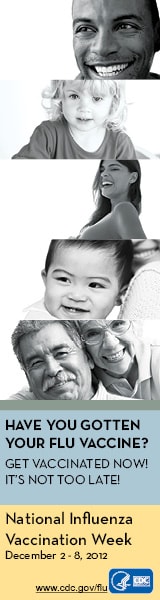
CDC made the announcement during a teleconference to kick off National Influenza Vaccination Week, which runs from Dec. 2-8. The observance was started in 2005 to remind people that it’s not too late to vaccinate if they haven’t gotten their flu shot before the holidays.
Frieden also had some good news: This year’s flu shot, which protects against different types of flu strains than last year’s shot, is almost a perfect match for the types of flu that doctors and hospitals are finding in the U.S. This means that people who have already had their flu shot this year will be well-protected.
The CDC recommends that almost everyone 6 months of age and older gets a flu shot every year. It’s especially important for people at high risk for complications from influenza — like pregnant women, young children, older adults and people with chronic diseases — to prevent getting the flu with a seasonal flu shot. (Find out more about high risk groups on CDC’s website.)
It takes about two weeks for the flu shot to fully take effect, so right now is a great time to get the flu vaccine. As Frieden reminded us this week, “When you get together with your friends and family, be sure you spread good cheer and give presents, and that you don't share infections and spread the flu.”
Here’s to healthy, happy holidays for all!
Monday, November 19, 2012
Get Ready Mailbag: What kind of flu shots are there?
 Welcome to another installment of the Get Ready Mailbag, when we take time to answer questions sent our way by readers like you. Have a question you want answered? Send an email to getready@apha.org.
Q: There are so many kinds of flu shots this year — how do I know which one is right for me?
A: We're glad you're planning on getting your flu shot. Every year there is a different combination of flu strains in the vaccine. This year’s flu shot is different than last year’s formula, so the shot you got last year will not protect you.
And you’re right about the kinds of flu shots - there are more options than ever! But there’s no reason to be confused. Here’s a breakdown of the different kinds of flu vaccinations options that are available in the U.S. this year:
- Injection: This is the most common type of flu vaccination. If you’ve had a flu shot before, you know what to expect: You’ll get a small amount of flu vaccine injected into your muscle (usually your deltoid, or shoulder).
- Nasal: The flu vaccine is also available as a nasal spray, though it should not be used by pregnant women or those with certain conditions, such as asthma.
- Intradermal flu shot: For people afraid of needles, this is the flu shot for you! The needle is much smaller on this type of shot, and the vaccine is delivered intradermally (under your skin) instead of in your muscle like the regular flu shot. This option can cost extra, so check with your doctor or pharmacy.
- High-dose flu shot: The high-dose flu shot is made for people 65 and older. It has a stronger dose of medication than the regular seasonal flu shot.
- Preservative-free, single-dose flu shot: Normally the flu-shot — like many other vaccines and injections — comes in a multi-dose bottle with a small amount of preservative known as thimerosol to help the vaccine stay fresh for longer. Some people prefer preservative-free flu shots. These are more expensive, come packaged in a single dose and usually have to be ordered ahead of time.
The best time to get your flu shot is early in the flu season, before flu is widespread in the community, because it can take up to two weeks for the flu shot to fully protect you. And don't forget to practice good hand hygiene and cold and flu etiquette year-round!
We hope this has helped you decide what flu shot is right for you. If you need to find out where to get your flu shot, check out HealthMap's Flu Vaccine Finder.
Wednesday, September 26, 2012
Back to school? Tips for keeping your family healthy!
With kids — and adults! — heading back to school, now is a perfect time to start getting ready for flu season. Here are the top six things you can do to keep you and your family healthy this fall:
1. Get your flu shot as soon as possible. The Centers for Disease Control and Prevention recommends that everyone ages 6 months and older get a seasonal flu shot every year. This year, the flu shot covers two new strains of the flu, which means that last year’s shot won’t cover you for the types of flu that are predicted to be most common this fall. If you don’t know where to go to get your flu shot, check out HealthMap’s Vaccine Finder to find a location near you!
2. Make sure your children are up to date on their other shots. Your child’s school will provide you with a list of required vaccinations that is based on CDC immunization schedules for children and teens.
Childhood vaccinations are especially important this year because the U.S. is experiencing large outbreaks of diseases that can normally be prevented with vaccines. For example, 46 states have reported higher than average cases of pertussis, also known as whooping cough, in 2012. Pertussis is a serious disease that can be deadly, especially for young children.

3. Make sure you are also up to date on your shots. Did you know that adults sometimes need booster shots, too? For example, the Tdap vaccine is a common adult booster shot that protects against tetanus, diphtheria and pertussis. It’s recommended that adults get one Tdap booster, especially if they will be around newborn babies or if it’s been more than 10 years since their last booster shot.
If you’re not sure if your immunizations are up to date, you should talk to your health care provider. CDC also has a vaccine quiz that can help you figure out what shots you might need to get.
4. Practice good hand hygiene — and teach your family to do the same. We have lots of great fact sheets about hand-washing for children and adults!
5. Stay home if you are sick. If you have children, make a plan for how you’d care for them if they have to stay home from school.
6. Sign up for Flu Near You. Do you know that APHA is partnering on a cool flu reporting tool that lets you detect and report symptoms of flu? All you have to do is sign up at www.flunearyou.org, and once a week you’ll get an email that asks, “How are you feeling?” After you fill out a 10-second survey about your symptoms, you will see a map of your area that shows if people around you have flu-like illness. This is a great way to be a disease detective and learn about flu in your community.

What steps are you taking to keep you and your family healthy this year? Do you have any other tips? Let us know in the comments!
Subscribe to:
Posts (Atom)