Showing posts with label prevention. Show all posts

Thursday, April 23, 2015

It’s National Infant Immunization Week: Protecting against disease starts when we’re young

The recent measles outbreak is a good reminder of the importance of vaccinations. More than 160 Americans have gotten sick this year from a preventable disease that can cause serious illness or even death — and most were not vaccinated.

While protecting ourselves from contagious disease is a lifelong practice, it starts when we’re young. That’s why people across the country are celebrating National Infant Immunization Week April 18-25.

The observance promotes immunizations for children ages 2 or younger. It also recognizes the important role of vaccines and the workers at state and local health departments and other health professionals who give vaccinations to help safeguard our communities from disease.

Their contributions are remarkable. In the United States, we protect children and infants under age 2 from 14 vaccine-preventable diseases through immunization, including chickenpox, mumps and polio. Vaccines have dramatically decreased infant death and disability caused by preventable diseases.

Vaccines not only help protect vaccinated individuals, but also help to protect entire communities. A study from the Centers for Disease Control and Prevention reports that among children born during 1994-2013, vaccination will prevent an estimated 322 million illnesses, 21 million hospitalizations and 732,000 deaths during their lifetimes.

While we celebrate this week in the United States, people across the globe are recognizing World Immunization Week, organized by the World Health Organization. Despite many successes in improving health, one in five children globally still misses out on life-saving vaccines.

Vaccines are safe and effective, and have saved countless lives. They are one of the greatest public health accomplishments. But we need to make sure we have an adequate supply to reach everyone. And, most important, you have to get immunized for them to work.

Thursday, December 06, 2012

Earliest start to the flu season in nearly a decade — It’s not too late to vaccinate!

This week, officials at the U.S. Centers for Disease Control and Prevention announced that they are seeing increased flu activity around the country. Thomas Frieden, CDC director, said that this was “the earliest regular flu season in nearly a decade.” He also warned that “this could be a bad flu year.”

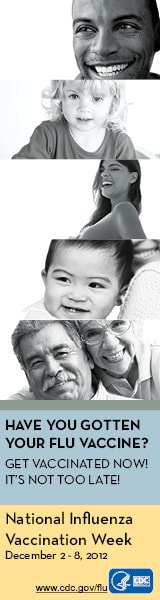
CDC made the announcement during a teleconference to kick off National Influenza Vaccination Week, which runs from Dec. 2-8. The observance was started in 2005 to remind people that it’s not too late to vaccinate if they haven’t gotten their flu shot before the holidays.

Frieden also had some good news: This year’s flu shot, which protects against different types of flu strains than last year’s shot, is almost a perfect match for the types of flu that doctors and hospitals are finding in the U.S. This means that people who have already had their flu shot this year will be well-protected.

The CDC recommends that almost everyone 6 months of age and older gets a flu shot every year. It’s especially important for people at high risk for complications from influenza — like pregnant women, young children, older adults and people with chronic diseases — to prevent getting the flu with a seasonal flu shot. (Find out more about high risk groups on CDC’s website.)

It takes about two weeks for the flu shot to fully take effect, so right now is a great time to get the flu vaccine. As Frieden reminded us this week, “When you get together with your friends and family, be sure you spread good cheer and give presents, and that you don't share infections and spread the flu.”

Here’s to healthy, happy holidays for all!

Monday, October 15, 2012

Celebrating Global Handwashing Day

Today is Global Hand-washing Day. Yes, you heard us right: Hand-washing has its own worldwide celebration.

Why make such a fuss over washing your hands? Because hand-washing is a pretty big deal! Here in the U.S., we might take soap and water for granted, but it is one of the most important things a person can do to stay healthy. In fact, a study of students in Detroit showed that people who wash their hands properly reported 24 percent fewer colds and 51 percent fewer stomach illnesses.
"Wash Your Hands" poster in 24 launguages, courtesy the Minnesota Department of Health
Image: "Wash Your Hands" poster in 24 languages,
courtesy Minnesota Department of Public Health

So how do you wash your hands the right way? Take five:
  1. Use clean, warm water.
  2. Lather up with soap.
  3. Wash your hands for at least 20 seconds — long enough to say the alphabet, or sing the “happy birthday” song twice.
  4. Rinse your hands with clean water.
  5. Dry your hands.
If soap and clean water are not available, you can use an alcohol-based hand sanitizer with at least 60 percent alcohol content.

That’s it! If you start practicing healthy hand habits today, each and every time you wash your hands, you’re already on your way to a healthier you.

For more information about hand-washing, and for tips on talking to kids, teens and adults about the best way to wash their hands, check out our free fact sheets!

Friday, October 12, 2012

The biggest disaster threat in the US – and what YOU can do to prevent it!

What disaster poses the biggest threat in the U.S.?

You might be surprised to find out that it’s not earthquakes, tornadoes, hurricanes or other severe weather: fires are the most common home disaster in our country. In 2010, the American Red Cross responded to a home fire an average of once every 8 minutes.

That’s the bad news. The good news is that — unlike other disasters — most home fires can be prevented!

Oct. 7-13 is National Fire Prevention Week so we wanted to share some tips to help you get ready for fires at home:
  • Make sure you have a smoke detector installed on every floor, and change the batteries at least once a year. We recommend checking your smoke detectors and emergency stockpiles when you change your clocks on Nov. 4, 2012 – or as we like to call it, Set Your Clocks, Check Your Stocks day!
  • Make sure you think about what your family will do during a fire when you sit down to make emergency plans. FEMA recommends that you “Have Two Ways Out” of every room. And don’t forget to pick a place to meet up once everyone is out safely!
  • Check out our Home Disasters fact sheet [PDF] for more tips about preparing your home for disasters.
  • If you live in an area at risk for wildfires, you should make extra plans for your home and your family. Check out our recent blog post about wildfires, or download our fact sheet [PDF] for more info!
We hope this information helps you and your family prepare for a fire and stay safe.

Do you have any stories to share about home fires? Let us know in the comments or send us an email!

Friday, August 03, 2012

Get Ready Mailbag: Do ticks spread babesisos? How do I protect myself?

Welcome to another installment of the Get Ready Mailbag, when we take time to answer questions sent our way by readers like you. Have a question you want answered? Send an email to getready@apha.org.

Q: My cousin was recently diagnosed with babesiosis, which her doctor said comes from ticks. I’ve never heard of it — am I at risk, too? How can I protect myself?

A: Your cousin’s doctor is right. The main way that people get babesiosis is from a tick bite.

The disease is spread by a parasite called Babesia which lives inside of certain types of ticks. These ticks are so small — about the size of a poppy seed — that you may not even know if you’ve been bitten.
[Photo: Young form of Ixodes scapularis, 
the type of tick that spreads Babesiosis.
Photo by G. Hickling,
University of Tennessee, courtesy CDC.]

Babesiosis can cause flu-like symptoms, such as fever, chills, headaches, body aches, tiredness, nausea and loss of appetite. Health professionals may suspect this illness if you live in the Northeast or upper Midwest and if these symptoms show up during the summer months. However, some people don’t show any symptoms at all, so preventing tick bites is the key! (http://www.cdc.gov/parasites/babesiosis/prevent.html)

To prevent tick bites:
  • Hike on well-marked trails and stay out of bushes and long grass.
  • Make sure to cover your skin with long pants and shirts.
  • Apply bug spray.
  • After walking through wooded areas or spending time outdoors, inspect your clothes and body for ticks.
The good news is that babesiosis is easy to treat once it is detected.

We hope your cousin recovers quickly and that you continue to stay safe!

Friday, June 08, 2012

Summer Safe: Tips for staying healthy in hot weather

With record-setting warm weather across the U.S. this year, we wanted to kick off our Summer Safe series with some timely information about beating the summer heat.

To get the scoop about hot weather safety, we sat down with Linda Degutis, DrPH, MSN. Degutis is the director of the National Center for Injury Prevention and Control at the Centers for Disease Control and Prevention, and she had a lot of advice about heat-related illnesses.

Though many people want to have ‘fun in the sun’ during the summer months, really hot weather can pose a dangerous threat to people’s health. As Degutis explained, “extreme heat can lead people to have very high body temperatures,” which could quickly lead to brain damage, organ failure or even death.

Degutis, a past president of APHA, warned about the two heat-related illnesses people should avoid in hot weather: heat stroke and heat exhaustion. Heat stroke is more serious, because your body can lose its ability to cool itself down and your body temperature can get dangerously high.

These are the symptoms you should look out for (click to view larger):


The people who are most at risk for heat-related illness are the elderly, young children and people with chronic medical conditions. Also, people who spend a lot of time out-of-doors, such as construction workers and landscapers, the homeless and those who exercise in the heat are at risk for the dangerous side effects of spending too much time in hot weather.

That’s the bad news. “The good thing about all of this is that we can prevent heat-related illnesses by taking some relatively simple precautions,” Degutis explained.
These include:

  • During very hot weather, stay inside where it’s cool. If you don’t have air-conditioning in your house, go somewhere that does: A library, a grocery store, an indoor mall. Communities may also set up cooling centers where people can escape the heat, so check with your local government. 
  • Stay hydrated by drinking plenty of water. Alcoholic beverages and sugary drinks like soda and juice can make you more thirsty, so stay away from those as much as possible in the heat.
  • You can still stay active and enjoy the outdoors, but consider saving your exercise or outdoor activities for the cooler parts of the day: morning and evening. Avoid being outside in the middle of the day when it’s hottest.
  • Wear lightweight, light-colored clothing, because dark clothes or heavy fabric can trap heat. Also, make sure you wear a hat and sunscreen — sunburns put you at higher risk for heat-related illnesses!
  • Sign up for free weather alerts via email or text, so that you’ll know if there is an excessive heat warning for your area.
  • Don’t forget to check on friends, older family members and elderly neighbors in very hot weather.

For more information about staying safe in hot weather, you can listen to the podcast of our interview with Degutis. We also have a full transcript of the interview, and we created a handy Healthy You tipsheet about staying safe in the heat that you can print and share.

Friday, May 18, 2012

Flu Friday: Canada fails its first Flu Report Card


Happy Flu Friday!

For the first time, some of America’s northern neighbors scored themselves on the flu — and they didn’t make the grade.

Image: Flu Report Card,
courtesy The Lung Association
The British Columbia and Quebec Lung Associations created a Flu Report Card to see how well prepared their provinces were compared to the rest of the country.

Released this week, the report card showed the percentage of adults that received a seasonal flu vaccination during the 2011-2012 flu season. They compared the rate to the percentage of people who reported getting the flu this year. Not surprisingly, provinces where more adults got flu shots reported lower rates of the flu.

Canada’s two most populated provinces, Ontario and Quebec, received the worst grades: D- and F, respectively. Quebec failed because its vaccination rate was the lowest — only 27 percent of adults got the flu shot this year, so one in four people living there got the flu. This is especially bad news considering the weak flu season we’ve had in North America this year.

“Clearly, Quebeckers are not ready for a severe flu season," said Dominique Massie, executive director of the Quebec Lung Association, in a news story.

The report found some good news: 52 percent of British Columbians received the flu vaccine this year, and they reported the lowest rates of the flu, at 10 percent. And overall, more Canadians are getting the flu shot every year. The researchers also found that more people said they would get the flu shot if it was delivered with a smaller needle.

What does this mean for the U.S.? Well, the biggest lesson is that if more people get the flu shot, fewer people get the flu.

We here at Get Ready think it would be really cool to have a Flu Report Card in the U.S. What do you think? If your state was failing at the flu — or passing with flying colors — would that change your flu shot behavior? Let us know in the comments!


Friday, April 06, 2012

Flu Fridays: How is the flu shot made? (Part 1)

Happy Flu Friday! Here at Get Ready, we spend a lot of time talking about the importance of getting your flu shot every year. But have you ever wondered how the vaccine is made?

There are actually two parts to making a flu shot: First, experts decide what types of flu will be included in the flu shot for the next year. Then, vaccine manufacturers start making the flu shots so that by the time the next flu season starts, millions of doses will be available. Today we’ll talk about the first part of the question: How do they decide what goes into a flu shot?

Image courtesy
CDC/ Doug Jordan, M.A.
Every year, in more than 100 countries around the world, health workers and scientists collect samples from people who are sick with the flu. These samples are sent to five international labs, chosen by the World Health Organization, that test the samples and find out what strains of influenza are most common. (In case you were wondering, the five labs are in the U.S., England, Australia, China and Japan.)

In the beginning of the year, WHO calls a big meeting with all of these international flu researchers. They figure out which types of influenza viruses were most common over the past year and then decide which strains should be included in the next seasonal flu shot. The formulas can change every year, which is why it is important that you get a new flu shot every season.

This big WHO vaccine composition meeting just happened in February. Participants decided that next year’s flu shots should protect people against two kinds of influenza A, H1N1 and H3N2, and one kind of influenza B. To learn about the difference between influenza A and B, check out our blog post about what causes the flu. You can also learn more about the vaccine selection process from the Centers for Disease Control and Prevention.

Once WHO makes its recommendations, vaccine companies around the world start making flu vaccines for the next season. While WHO recommends specific vaccine viruses for vaccine production, each country makes its own decision for vaccine licensing in its country. Making the new vaccine can take six to nine months, which means that companies are already starting to make your flu shot for next year!

Want to learn more? Check out Part 2 on how the flu shot is made, where we take a closer look at the flu shot manufacturing process.

Friday, March 30, 2012

Flu Fridays: Could your job put you at risk for the flu?

It's Flu Friday, and we want to know: Are you sick of your job? Or is your job making you sick?

A new study looked at the jobs of people who were hospitalized with the flu during the 2009–2010 flu season. What researchers found was surprising: People who worked in some fields were more likely to get a very bad case of the flu than people who worked other types of jobs.

What kind of jobs were related to workers having a serious case of the flu? At the top of the list were health workers. This wasn't breaking news, because nurses, doctors and other health workers have to deal directly with sick people. But some other surprising jobs made the list:

  • Transportation and warehouse workers: 1.5 times more likely than the average worker to get serious flu.
  • Administrative support and waste management workers: 1.5 times more likely.
  • Hotel and restaurant workers: 1.3 times more likely.
  • Retail workers: 1.1 times more likely.

The study found that other jobs — such as teachers and construction workers —  were less likely than the average U.S. worker to get sent to the hospital from a serious case of the flu. (That may surprise any teacher who has had to deal with lots of sick students!)

But if this news makes you want to quit your job, not so fast!  First off, the study found that in general, people with jobs landed in the hospital a lot less often than people who didn't work at all. So having a job — and a regular paycheck — is generally a good thing for your health, according to the study.

Plus, the study found other things could have increased people's risk for getting very sick with the flu aside from their job. For example, researchers found that more than 30 percent of people who worked in the hotel and restaurant industry were smokers — and smoking can really increase your chances of having serious complications if you get the flu. Other things that made people more likely to get really sick from flu included having a chronic disease, such as diabetes or high blood pressure, and not having a regular place to go for health care, such as a doctor or clinic that you go to every time you get sick.

So what does it all mean? No matter what kind of job you have (or want to have), this new study doesn't change the fact that you can do a lot of things to protect yourself from a bad case of the flu.

Our top tips:
  • Get a seasonal flu shot every year.
  • Wash your hands and practice good hygiene.
  • In general, keep yourself as healthy as possible to prevent things like diabetes and heart disease.
  • If you smoke, quit smoking.
  • If you get sick, see your doctor.
  • If you get the flu, stay home from work. You'll get better faster and you won't spread the flu to your coworkers!

Friday, March 02, 2012

Flu Fridays: What parents can do to protect kids from the flu

Last week, the Centers for Disease Control and Prevention announced that the U.S. flu season has officially begun, making this the latest start to a flu season in 29 years.

While flu activity has been relatively low compared to other flu seasons, CDC did report some sad news: There have been three child deaths so far this year from influenza. In the U.S., an estimated 20,000 children younger than age 5 are hospitalized every year from complications with the flu, which is why CDC considers young children a high-risk group.

Thankfully, there are things that any parent can do to help protect their child from the flu.

Parents with children 6 months of age and older can take their child to get a flu shot. CDC recommends that all children 6 months of age and older be vaccinated against the flu. This is especially true for children with asthma or other chronic health problems, because they are at higher risk for complications if they get the flu.

[Image: Child receiving flu shot, courtesy CDC/ Judy Schmidt]

Parents and siblings of babies younger than 6 months should get the flu shot themselves. Although a baby may be too young for the flu shot, family members can get vaccinated to reduce the chance of contracting the flu and passing it on to the baby. And parents should make sure that anyone who takes care of their baby — family members, baby sitters, nannies — are up-to-date on all vaccines, including seasonal influenza. For more information about children and the flu, check out CDC’s website. You can also read our Get Ready fact sheet that tells why it’s important for kids to get vaccines.

Pregnant women are also considered a high-risk group for the flu, because the flu can cause more severe complications during pregnancy, putting both the woman and developing fetus at risk. The great news is that the flu shot is safe for pregnant women, and the shot will also protect her fetus as well! Because of the safety and benefits of vaccination for pregnant women, the popularity of the flu vaccine has been growing in recent years. At least half of pregnant women in the U.S. reported getting their seasonal flu shot last year.

Aside from vaccination, parents of young children can teach good hand-washing techniques and other hygiene habits, such as covering their mouth and nose when they sneeze. The Get Ready campaign has a great selection of fact sheets about hand-washing for children of all ages to help parents and teachers.

For more information about families whose lives have been touched by influenza, visit Faces of Influenza and Families Fighting Flu.

We hope that this information will help your family stay flu-free this season!

Tuesday, January 31, 2012

Are you ready for whooping cough?

If you’ve read or watched the news lately, you may have heard about an increase in pertussis, or “whooping cough,” infections. Several states are now reporting new cases, including West Virginia, Pennsylvania, New York, Rhode Island and Maine.

Pertussis is caused by bacteria called Bordetella pertussis. It causes respiratory illness that starts out like the common cold, with symptoms like a runny nose and low fever. After a week or two of illness, people infected often develop exhausting fits of coughing, which sometimes end with a “whooping” sound — hence the nickname, “whooping cough.” (Here’s what a young girl with whooping cough sounds like.) The coughing is so violent that it can cause people to vomit, pass out or even fracture their ribs. In other words, it’s a serious illness. Read more about pertussis on the National Foundation for Infectious Disease’s website.

Without treatment, pertussis can last for 6-10 weeks. While 10 weeks of violent coughing may sound terrible for anyone, babies are at especially high risk. More than half of infants that contract pertussis are hospitalized each year with life-threatening complications. In the U.S., 25 of the 27 deaths from pertussis in 2010 were babies who were less than a year old.

That’s the bad news. The good news about pertussis is this: There’s a vaccine for that! (Actually, there are two: One for babies and one for older children and adults.)

The Centers for Disease Control and Prevention recommends that babies get a series of shots called DTaP at 2, 4 and 6 months of age, and then two booster shots.

Older children and adults also need to be immunized regularly — even people who were immunized as a baby aren’t protected for life. The shot for teens and adults is called Tdap, and it’s recommended that most people get a booster shot about every 10 years.

This is especially true for pregnant women, new parents and anyone who spends time around newborn babies, because parents, older children and other caregivers can spread the disease to a new baby in their family without knowing it. You can listen to one mother’s story in this video from Parents of Kids with Infectious Diseases, an organization that provides educational information.


[Video: One family’s struggles with pertussis, from Parents of Kids with Infectious Diseases, via CDC.]

You can read more about pertussis vaccinations on CDC’s website. If you think it’s been a while since you’ve had a Tdap shot, the best thing to do is to contact your health care provider.

To end this post on a happy note, here is some good news from California: The state had a large outbreak of pertussis in 2010, which we wrote about on the Get Ready Blog. Hoping to control the outbreak, state health officials launched a big effort to educate and vaccinate people of all ages — and their hard work paid off! The California Department of Public Health announced last week that the number of pertussis cases dropped by more than two-thirds last year (dropping from 9,154 cases in 2010 to 2,795 cases in 2011). And even better, there were no reported deaths from pertussis in 2011.

So there you have it: The vaccine is your best defense against pertussis. Make sure your immunizations are up to date today so that you can be ready if whooping cough comes your way tomorrow!